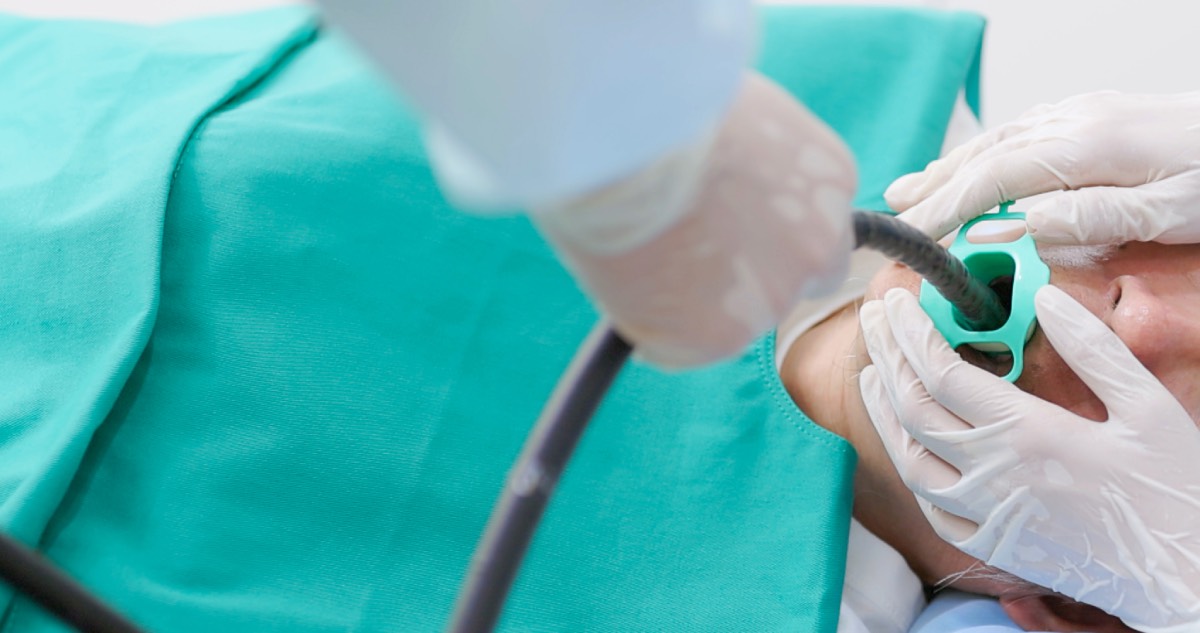
Esophagogastroduodenoscopy (EGD), also known as upper endoscopy, is a commonly performed procedure used to evaluate the esophagus, stomach, and duodenum. EGD is generally performed under moderate or deep sedation to improve patient comfort and procedural tolerance. However, in certain settings, EGD can be performed without systemic sedation. This approach primarily relies on topical anesthesia and careful patient selection.
Performing EGD without sedation means that systemic sedatives such as propofol or benzodiazepines are avoided. Instead, clinicians rely on local or topical anesthesia, most commonly lidocaine spray applied to the oropharynx. This numbs the gag reflex and allows the endoscope to pass more comfortably through the throat 1–3.
One of the main benefits of performing EGD without sedation is a reduction in the risk of respiratory depression, hypotension, and adverse drug reactions that come with the administration of sedatives. Other advantages include quicker recovery and decreased monitoring requirements. Patients undergoing EGD without sedation can resume normal activities almost immediately after the procedure, as there is no need for post-anesthesia monitoring or recovery time. Additionally, the patient does not require an escort home, which can be a logistical benefit.
Performing EGD without sedation also enhances cost efficiency, as it removes the need for anesthesia personnel, medications, and extended recovery room use, lowering overall procedural costs. This makes EGD without sedation a particularly attractive option in resource-limited settings. Finally, patients can respond better to instructions, such as swallowing to facilitate scope passage, which may improve technical ease in some cases.
Despite these advantages, EGD without sedation is not suitable for all patients. Discomfort and anxiety remain the biggest obstacles. Even with topical anesthesia, patients may experience gagging, throat irritation, or a sensation of choking, which can lead to poor tolerance and incomplete procedures. Ideal candidates for EGD without sedation are motivated individuals with low anxiety, good pain tolerance, and a clear understanding of what to expect during the procedure. In contrast, patients with a strong gag reflex, high anxiety levels, or prior negative experiences with endoscopy may not tolerate the procedure well.
Procedural difficulty is another challenge: movement, retching, or lack of cooperation can make visualization more challenging and may potentially compromise diagnostic accuracy. In some cases, the procedure may need to be aborted and rescheduled with sedation.
From a provider’s perspective, carrying out EGD without sedation requires strong communication skills and experience. The endoscopist and nursing staff must guide the patient through each step, reassuring them and maintaining cooperation throughout the procedure 7–11.
References
1. What Is an EGD? Cleveland Clinic https://my.clevelandclinic.org/health/procedures/22549-egd-procedure-upper-endoscopy.
2. Upper Endoscopy – Risks, Prep, & Procedure | Made for This Moment. Made For This Moment | Anesthesia, Pain Management & Surgery https://madeforthismoment.asahq.org/preparing-for-surgery/procedures/upper-endoscopy/.
3. de la Morena, F. et al. Usefulness of applying lidocaine in esophagogastroduodenoscopy performed under sedation with propofol. World J Gastrointest Endosc 5, 231–239 (2013). DOI: 10.4253/wjge.v5.i5.231
4. Local and Regional Anesthesia: Overview, Anesthesia, Complications. https://emedicine.medscape.com/article/1831870-overview?form=fpf.
5. What Is Local Anesthesia? Cleveland Clinic https://my.clevelandclinic.org/health/procedures/local-anesthesia.
6. Weinstein, E. J. et al. Local anaesthetics and regional anaesthesia versus conventional analgesia for preventing persistent postoperative pain in adults and children. Cochrane Database Syst Rev 2018, CD007105 (2018). DOI: 10.1002/14651858.CD007105.pub4
7. Goudra, B. & Singh, P. M. Anesthesia for gastrointestinal endoscopy: A subspecialty in evolution? Saudi J Anaesth 9, 237–238 (2015). DOI: 10.4103/1658-354X.154691
8. Isenberg, G. Topical anesthesia: To use or not to use—that is the question. Gastrointestinal Endoscopy 53, 130–133 (2001). DOI: 10.1067/mge.2001.112093
9. Risks and benefits. ASRA Pain Medicine https://asra.com/patient-information/regional-anesthesia/risks-and-benefits.
10. Early, D. S. et al. Guidelines for sedation and anesthesia in GI endoscopy. Gastrointestinal Endoscopy 87, 327–337 (2018). DOI: 10.1016/j.gie.2017.07.018
11. Hudgi, A., Parthasarathy, S., Mirza, A., Woodcock, A. & Goosenberg, E. Esophagogastroduodenoscopy (EGD). in StatPearls (StatPearls Publishing, Treasure Island (FL), 2026).